Fahrenheit and Celsius represent common temperature scales globally, with Fahrenheit primarily used in the US and Celsius dominating worldwide.
Historical Context of Fahrenheit
Daniel Gabriel Fahrenheit, a German physicist, developed the Fahrenheit scale in 1724. He sought a reliable and accurate temperature measurement system, moving away from earlier, less consistent methods. Fahrenheit initially based his scale on zero degrees representing the freezing point of a brine solution – a mixture of water, ice, and ammonium chloride.
He then refined it using two fixed points: the freezing point of water and a presumed normal human body temperature. Interestingly, his initial estimate for human body temperature was 96°F, slightly lower than the modern accepted value of 98.6°F. The scale gained traction due to its precision and was widely adopted, particularly in English-speaking countries, before the rise of the metric system and Celsius.
Historical Context of Celsius
The Celsius scale, originally known as the centigrade scale, has roots in the work of Swedish astronomer Anders Celsius in 1742. Celsius proposed a scale where 0 degrees represented the boiling point of water and 100 degrees the freezing point – the inverse of the modern scale. This was later reversed by Carl Linnaeus and others, establishing the current convention where 0°C is the freezing point and 100°C is the boiling point of water.
The Celsius scale’s simplicity and direct relation to the properties of water facilitated its adoption alongside the burgeoning metric system, promoting standardization and ease of use in scientific and everyday applications globally.

Understanding the Fahrenheit Scale
Fahrenheit defines water’s freezing point at 32°F and boiling point at 212°F, creating a 180-degree interval, developed by Daniel Gabriel Fahrenheit in 1724.
Freezing and Boiling Points in Fahrenheit
Fahrenheit’s scale establishes crucial reference points for everyday understanding of temperature. Water freezes at precisely 32 degrees Fahrenheit (32°F), a value widely recognized in the United States. This point serves as a baseline for colder temperatures. Conversely, water reaches its boiling point at 212 degrees Fahrenheit (212°F) under standard atmospheric pressure, indicating a transition to a gaseous state.
These fixed points are fundamental to the scale’s structure. The 180-degree interval between freezing and boiling allows for relatively granular temperature measurements. Understanding these benchmarks is essential when interpreting weather reports, cooking instructions, or scientific data presented in Fahrenheit. These values are key when creating a Fahrenheit to Celsius conversion table, ensuring accurate representation of temperature differences.
The 180-Degree Interval
Daniel Gabriel Fahrenheit deliberately designed his scale with an interval of 180 degrees between the freezing and boiling points of water. This choice wasn’t arbitrary; it stemmed from his desire for a scale with finer gradations than existing systems. This larger interval allows for more precise temperature distinctions compared to scales with fewer divisions.
The 180-degree span is a defining characteristic of the Fahrenheit scale, influencing how temperatures are perceived and measured. When constructing a Fahrenheit to Celsius conversion table, acknowledging this interval is crucial for accurate calculations. Each degree Fahrenheit represents a smaller temperature change than a degree Celsius, a direct consequence of this wider range.
Daniel Gabriel Fahrenheit’s Contribution
Daniel Gabriel Fahrenheit, a German physicist, proposed his temperature scale in 1724, revolutionizing temperature measurement. He meticulously constructed thermometers using mercury and alcohol, striving for greater accuracy than previous methods. His scale wasn’t based on the freezing and boiling points of water initially, but rather on a brine solution – a mixture of water, ice, and ammonium chloride.
Fahrenheit’s dedication to precision laid the groundwork for standardized temperature readings. Creating a Fahrenheit to Celsius table relies on understanding his original scale’s foundation. His work, though eventually superseded by Celsius in many scientific contexts, remains significant, particularly in the United States, and continues to influence daily life and temperature reporting.

Understanding the Celsius Scale
Celsius, part of the metric system, defines 0° as water’s freezing point and 100° as its boiling point, offering a straightforward temperature assessment.
Origins of the Celsius Scale
Anders Celsius, a Swedish astronomer, initially proposed the scale in 1742, though it was originally designed with 0 representing the boiling point of water and 100 representing the freezing point. This was later reversed by Carl Linnaeus, who popularized the scale in its current form – 0 for freezing and 100 for boiling.
Celsius aimed to create a more practical and scientifically sound temperature scale, moving away from the arbitrary reference points used in earlier systems. His work built upon earlier attempts to standardize temperature measurement, contributing to the development of the metric system. The scale’s simplicity and decimal-based nature made it easily adaptable for scientific and everyday use, eventually becoming the standard in most of the world.
The adoption of Celsius was gradual, but its alignment with the metric system and its intuitive reference points – based on the properties of water – ultimately led to its widespread acceptance.
Water’s Freezing and Boiling Points in Celsius
The Celsius scale defines the freezing point of water at 0°C and the boiling point at 100°C under standard atmospheric pressure. These values serve as fundamental reference points for the scale, making it easily relatable to common experiences.
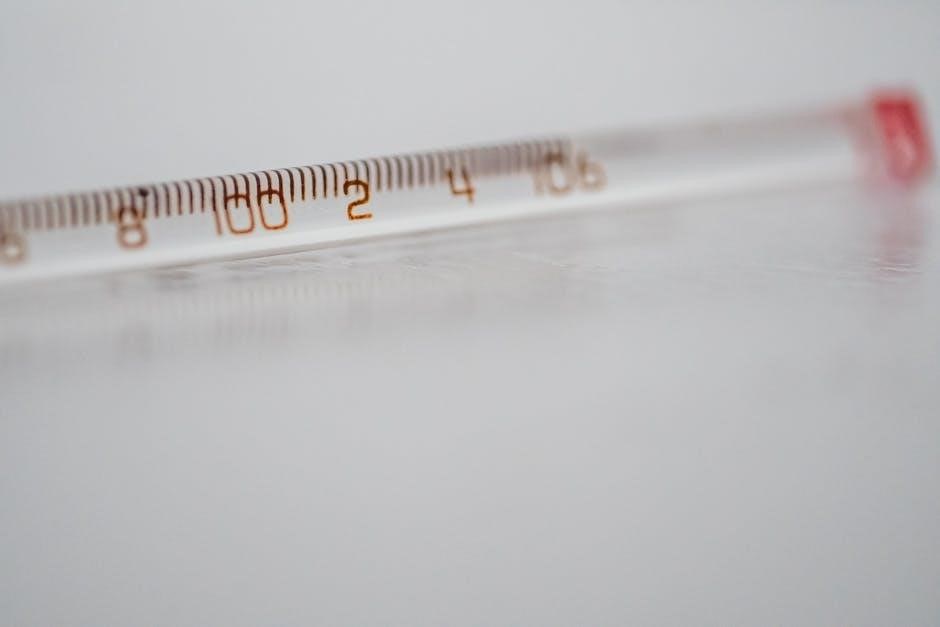
This definition is crucial for practical applications, from everyday cooking to scientific experiments. The consistent and easily reproducible nature of water’s phase transitions provides a reliable basis for temperature measurement. The simplicity of these benchmarks contributes to the scale’s widespread adoption globally.
Understanding these points is essential when interpreting temperature readings and performing conversions, particularly when creating or utilizing a Fahrenheit to Celsius table for quick reference.
Celsius as Part of the Metric System
The Celsius scale seamlessly integrates within the internationally recognized metric system, renowned for its decimal-based structure and ease of use. This integration simplifies calculations and conversions, fostering consistency across scientific and everyday applications.
Being part of the metric system means Celsius aligns with units like meters, kilograms, and seconds, promoting a unified approach to measurement. This standardization is particularly valuable in international collaborations and scientific research, reducing ambiguity and errors.
When constructing a Fahrenheit to Celsius table, the metric foundation of Celsius facilitates precise and logical organization of temperature values, enhancing its practicality and usability.

The Fahrenheit to Celsius Conversion Formula
Converting between scales requires a formula; a Fahrenheit to Celsius table relies on C = (F ー 32) × 5/9 for accurate temperature translations.
The Formula: C = (F ‒ 32) × 5/9
This equation is the cornerstone of Fahrenheit to Celsius conversions, essential for creating an accurate Fahrenheit to Celsius table. First, subtract 32 from the Fahrenheit temperature. This adjustment accounts for the differing zero points of the two scales. Subsequently, multiply the result by 5/9 – a fraction representing the ratio of degree size between the scales.
Understanding this ratio is crucial; a Celsius degree is larger than a Fahrenheit degree. Applying this formula consistently ensures precise temperature conversions, vital for any comprehensive table. The formula’s simplicity belies its power in bridging these two widely used temperature systems, making temperature data universally understandable.
Explanation of the Formula Components
The ’32’ in the formula C = (F ー 32) × 5/9 represents the offset between the Fahrenheit and Celsius scales’ zero points; water freezes at 32°F but 0°C. Subtracting 32 normalizes the Fahrenheit value to a comparable starting point. The ‘5/9’ embodies the differing degree increments.
A Celsius degree is larger than a Fahrenheit degree, meaning fewer Celsius degrees are needed to span the same temperature range. This fraction accurately scales the temperature difference. When constructing a Fahrenheit to Celsius table, understanding these components ensures each conversion is mathematically sound, providing a reliable resource for quick temperature assessments.

Creating a Fahrenheit to Celsius Table (PDF)
PDF tables offer portability and consistent formatting for Fahrenheit to Celsius conversions, making them ideal for offline access and sharing.
Why Use a PDF Table?
PDF tables provide a universally accessible and reliable method for displaying Fahrenheit to Celsius conversions. Unlike spreadsheets or documents that may render differently across platforms, a PDF ensures consistent formatting, regardless of the user’s operating system or software.
This consistency is crucial for accuracy, especially in fields like science, cooking, or weather monitoring where precise temperature readings are essential. PDFs are also easily shareable via email or websites without the risk of alteration. Furthermore, they are portable; a PDF table can be viewed on any device – computers, tablets, or smartphones – without requiring specialized software.
The format is static, preventing accidental changes to the conversion data, and they are generally smaller in file size than equivalent spreadsheet documents, making them efficient to store and transmit.
Software Options for Table Creation
Several software options facilitate creating a Fahrenheit to Celsius conversion table in PDF format; Microsoft Excel is a popular choice, allowing for easy formula implementation and subsequent export to PDF. Alternatively, Google Sheets offers similar functionality with cloud-based accessibility and collaboration features.
For more advanced table design and PDF creation, Adobe InDesign provides professional-level control over layout and typography. Open-source alternatives like LibreOffice Calc also offer robust table creation and PDF export capabilities. Online PDF editors, such as Smallpdf or iLovePDF, can be used to directly create and edit tables within a PDF document.
The best choice depends on your specific needs and technical expertise, ranging from simple spreadsheet solutions to dedicated design software.
Data Points for a Comprehensive Table
A comprehensive Fahrenheit to Celsius conversion table in PDF format should include data points at regular intervals for practical usability. Starting from freezing point (32°F / 0°C) and extending to boiling point (212°F / 100°C), increments of 10°F or 5°F are recommended.
Including values for common temperatures like typical body temperature (98.6°F / 37°C) and room temperature (around 72°F / 22°C) enhances the table’s relevance. Expanding the range beyond these common values, perhaps to -40°F (-40°C), provides broader coverage.
Consider adding data points for temperatures encountered in weather reports and cooking recipes, ensuring a versatile and informative PDF conversion resource.
Practical Applications of Conversion Tables
Conversion tables, especially in PDF format, are vital for quick temperature adjustments in weather, cooking, and scientific contexts globally.
Weather Forecasting
Weather forecasting frequently utilizes both Fahrenheit and Celsius, depending on the region. A readily available Fahrenheit to Celsius table, often in PDF format, becomes incredibly useful for international viewers or those accustomed to a different scale.
For example, a US audience typically receives temperatures in Fahrenheit, while many other countries rely on Celsius; A PDF table allows for instant conversion, ensuring everyone understands the predicted temperatures accurately. Forecasters can easily share these tables alongside their reports, enhancing clarity and accessibility. Having a quick reference guide eliminates calculation errors and promotes better public understanding of weather conditions, especially during extreme temperature events.
Cooking and Baking
Cooking and baking often require precise temperatures for optimal results. Recipes frequently originate from countries using either Fahrenheit or Celsius, necessitating quick and accurate conversions. A convenient Fahrenheit to Celsius table, ideally in PDF format, solves this issue efficiently.
Bakers, in particular, rely on exact oven temperatures. A PDF table provides an immediate reference, preventing errors that could ruin a delicate recipe. Similarly, cooks adapting international recipes benefit from a readily available conversion tool. Having a PDF version allows for easy printing and keeping it near the cooking station, ensuring consistent and successful culinary outcomes, regardless of the original temperature scale.
Scientific Research
Scientific research frequently demands meticulous temperature control and data recording, often requiring conversions between Fahrenheit and Celsius. A readily accessible Fahrenheit to Celsius table, particularly a portable PDF version, streamlines these processes. Researchers collaborating internationally may encounter data presented in different scales, making quick conversion essential for accurate analysis.
Maintaining consistency is paramount in experiments. A PDF table offers a reliable, offline reference point, minimizing errors during data interpretation. Furthermore, it facilitates the replication of experiments by providing a clear and standardized conversion method. The convenience of a PDF ensures researchers can easily access and utilize temperature conversions in laboratory settings.

Resources for Fahrenheit to Celsius Conversion
Numerous online resources offer Fahrenheit to Celsius conversion, including downloadable PDF tables for convenient, offline access and quick temperature referencing.
Online Converters
A plethora of online converters readily facilitate Fahrenheit to Celsius transformations, offering instant results without requiring any software downloads. These tools are exceptionally user-friendly; simply input the Fahrenheit temperature, and the equivalent Celsius value is displayed immediately. Many converters also provide reverse conversion capabilities, switching from Celsius to Fahrenheit with equal ease.
While not directly PDF-focused, these converters are invaluable for verifying values within a Fahrenheit to Celsius table created in PDF format. Popular options include those found on websites like Google, ConvertUnits.com, and many scientific calculators available online. These resources ensure accuracy and provide a quick cross-reference point when utilizing a PDF conversion chart, especially when needing to double-check specific temperature points.
Mobile Applications
Numerous mobile applications are available for both iOS and Android devices, providing convenient Fahrenheit to Celsius conversion on the go. These apps often include features beyond simple conversion, such as historical temperature data and customizable settings. Many offer offline functionality, making them useful even without an internet connection – ideal when referencing a PDF temperature table in remote locations.
For users of a PDF table, these apps can quickly verify calculated values or provide conversions for temperatures not explicitly listed. Search app stores for terms like “temperature converter” or “Fahrenheit Celsius” to find suitable options. Some apps even allow users to input data directly from a PDF, streamlining the conversion process and enhancing usability.
Pre-made PDF Tables Available Online
A wealth of pre-made Fahrenheit to Celsius PDF tables are readily accessible online, offering a quick and convenient solution for temperature conversions. These tables vary in comprehensiveness, ranging from simple charts covering common temperatures to detailed tables with conversions at one-degree intervals. Searching online using keywords like “Fahrenheit Celsius conversion table PDF” will yield numerous results.
These PDF resources eliminate the need for manual calculations or reliance on online converters, providing a static and reliable reference. They are particularly useful in environments where internet access is limited or unavailable. Ensure the PDF source is reputable to guarantee accuracy and avoid potential errors in the conversion data presented within the table.

Common Mistakes to Avoid
Incorrectly applying the conversion formula or rounding errors when creating or using a Fahrenheit to Celsius table PDF can lead to inaccurate results.
Incorrect Formula Application
A frequent error when constructing a Fahrenheit to Celsius table PDF involves misusing the conversion formula: C = (F ー 32) × 5/9. Users sometimes forget the crucial subtraction of 32 from the Fahrenheit temperature before multiplication.
Additionally, confusion arises regarding the order of operations. Failing to perform the subtraction first will yield a drastically incorrect Celsius value. Carelessly swapping the numerator and denominator in the 5/9 fraction is another common mistake.
Double-checking each calculation and verifying a few sample conversions with an online converter are essential steps to ensure the accuracy of your PDF table. Remember, a small error in the formula propagates throughout the entire table!
Rounding Errors
When creating a Fahrenheit to Celsius table PDF, rounding errors can accumulate and significantly impact the overall accuracy. Deciding on a consistent rounding rule – for example, rounding to the nearest tenth or whole number – is crucial.
Inconsistently rounding values throughout the table introduces discrepancies. While seemingly minor, these small errors compound, especially when converting a large range of temperatures. Using a spreadsheet program allows for controlling decimal places and minimizing these issues.
Consider the intended use of the PDF table; higher precision may be needed for scientific applications than for general weather conversions. Always document the rounding method used within the table’s notes.

Future Trends in Temperature Measurement
Digital thermometers and the Kelvin scale are gaining prominence, though Fahrenheit to Celsius table PDFs remain useful for quick reference and understanding.
Kelvin Scale
Kelvin (K) is the base unit of temperature in the International System of Units (SI), offering an absolute scale where zero represents absolute zero – the theoretical absence of all thermal energy. Unlike Fahrenheit and Celsius, which are defined by the properties of water, Kelvin is fundamentally linked to thermodynamic principles.
While a Fahrenheit to Celsius table PDF aids in converting between everyday scales, the Kelvin scale is crucial in scientific contexts like physics and chemistry. It avoids negative temperatures, simplifying calculations. Converting to Kelvin requires adding 273.15 to the Celsius temperature. Though not directly replacing conversion tables, the Kelvin scale’s precision is increasingly vital in modern scientific applications, offering a standardized and absolute temperature measurement.
Digital Thermometers
Digital thermometers have largely superseded traditional mercury thermometers, offering increased accuracy, safety, and convenience. Many modern digital thermometers feature automatic Fahrenheit to Celsius conversion, eliminating the need for manual calculations or reference tables – even a PDF version. These devices provide quick and precise readings, crucial for applications ranging from medical diagnoses to cooking and scientific experiments.
The ease of use and instant conversion capabilities of digital thermometers diminish reliance on conversion charts. However, understanding the underlying principles and formulas remains valuable, especially when encountering older instruments or needing to verify digital readings. Despite advancements, a readily available conversion resource can still prove useful in various situations.